Showing posts with label Performance. Show all posts

Friday, 3 October 2025

Why Animators Need a Change of Expression

"Ruber" animation by Alex Williams
One of the most common mistakes made by junior animators is the “frozen face.” A character might be moving beautifully through space—walking, talking, gesturing—but if their expression never shifts, the scene feels flat and lifeless. 

Why? Because real people don’t hold one expression for long.  In real life, our faces are in constant, subtle motion. Even when listening quietly, tiny changes in the eyebrows, mouth, or eyes reveal attention, doubt, curiosity, or impatience. These micro-shifts keep us alive and believable. In animation, a lack of change reads as stiffness or, worse, lifelessness.

Wednesday, 17 September 2025

Why Animators Should Hold on the Final Vowel

"O" shape by Cliff Nordberg
When animating Lipsync, animators should never forget to hold a few frames longer on the final vowel shape, and not snap back into the default mouth position too quickly.

This is because when we say a word, like "ooh", our lips stay in the "oo" shape for a while, even after we have stopped making any "oo" sounds.  Junior animators will often snap back to a default mouth position, just a couple of frames after the sound stops, instead of holding the pose for longer, and staying in the mouth shape. 

Try it yourself. Say the word "shoo" and see how long your lips hold the "oo" shape. It's probably about 6-8 frames longer than the sound itself lasts. 

Tuesday, 1 October 2024

Animate a Sneeze with Monty

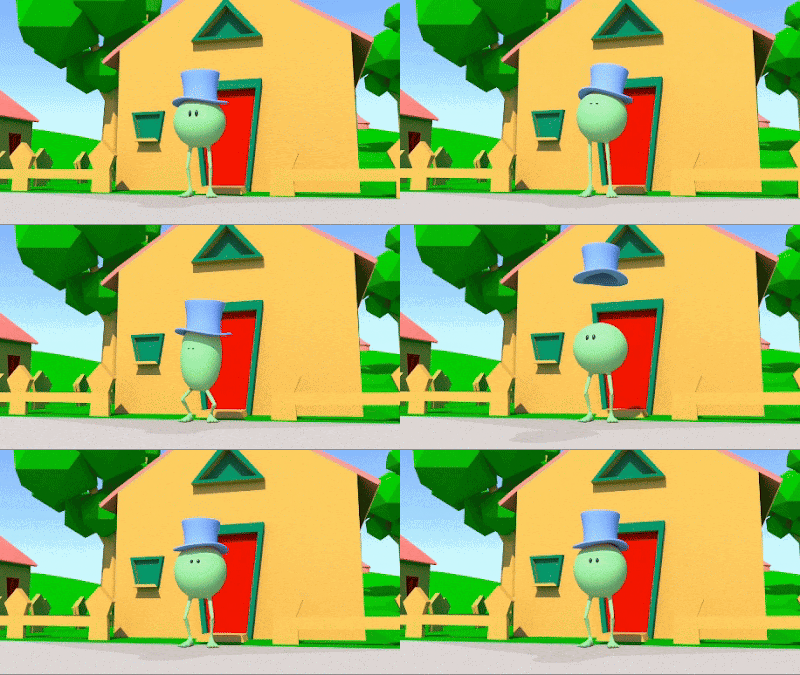
Animate a sneeze with Monty
In this beginner animation tutorial, we show how to animate a sneeze with Monty, the green pea.

A sneeze is an explosion of air, so we want a big anticipation, and then a big sneeze. 

If you have time, attach a hat to Monty's head, and animate it flying up in the air, spinning and landing again (you will need the Parentmaster plugin for this).

Sunday, 14 July 2024

Pantomime Animation Demo Reel


Above is a collection of some of the best pantomime animation shots completed by students at Animation Apprentice.  Pantomime animation is the art of performance without dialogue, in the tradition of the old silent movie stars such as Chaplin or Keaton - or a modern incarnation such as Mr Bean. Good pantomime animation communicates to the audience what the character is thinking and feeling - without dialogue. 

Thursday, 23 May 2024

Animate Willy "I'm Outta Here"

Willy: "I'm Outta Here!"
In this three part dialogue tutorial we show how to animate a cartoony character ("Willy") saying a line of dialogue.  The line is "I'm Outta Here!", taken from Iago in Disney's Aladdin. 

In the first part of the tutorial we block out the animation with Willy. In the second part, we add a "Smear Drawing" to simulate motion blur. 

In the third part we animate Willy's hat flying up in the air and landing. 

Thursday, 4 April 2024

Michael Caine Acting Lessons For Animators


Animated characters need to look at each other, so their eyes don't wander around screen.  Watch the short video above with acting legend Michael Caine for some tips from the master of screen acting.  The video itself is a little dated (1980s) but the lessons remain just as important today.  According to Caine, the number one lesson for stage actors is to "hold on to each others' eyes".  And, what is true for stage actors is true for animators too.  You can watch Caine's acting advice in the video above - the important part is all in the first 5 minutes.

Thursday, 28 March 2024

Acting and Performance Reel 2024


Above is a selection of the best acting and performance animation created by students at Animation Apprentice. The "Character Performance" reel includes work created by many of our talented students. All of our graduates should have at least one compelling acting shot on their reel, and one of the best ways to do this is to enter the monthly 11 Second Club.  Congratulations to all our students and recent graduates on their excellent work.

Thursday, 8 June 2023

Animate "Monty" Singing "Oh Yeah"

"Monty" sings "Ohhh Yeahhh". 
In the simple animation tutorial we show how to animate a character with no mouth ("Monty") singing a line of dialogue.  

But how can you animate dialogue and lipsync - with no lips?  The answer is - it's all in the performance.  If the body language is working, then the audience will believe that the character is speaking - even if the character itself has no mouth.  

In this tutorial we animate "Monty" saying (well, singing) a line of dialogue - "Ohhh Yeahhh". 

Friday, 30 December 2022

Character Animation by Muhanad Al Dasoqi


Above is an excellent piece of character animation by Animation Apprentice student Muhanad Al Dasoqi.  Having a great character animation piece on your demo reel is an important step in landing that crucial first job in the animation industry.  Animation studios are looking for animators who have good technical skills - but can also create genuinely entertaining work - the animation "X factor".

Monday, 5 December 2022

Character Animation by David Davis


A number of our students are currently tackling the 11 Second Club, the monthly competition in which animators compete to bring a line of dialogue to life, testing not just their technical skills but also their powers of imagination. Students must find performance and acting choices that create an entertaining and well-realised piece of animation. In the example above, one of my former students David Davis demonstrates strong, well-chosen choices for this very witty piece of character animation.

Friday, 22 April 2022

How To Create Thumbnails for Animation


How do you create thumbnail sketches for character animation? Learning how to create thumbnail sketches is a very important skill, even for animators who don't draw well, because thumbnail sketches are an important tool for planning animation.  Even 3D animators who aren't that comfortable with drawing are encouraged to have a go at the thumbnailing process, because it is so valuable for planning character animation.  Watch the video above to see how to create simple but expressive thumbnail sketches for this month's "11 Second Club"

Tuesday, 20 October 2020

Using Live Action Reference for Animation

Live Action Ref by Eilin Berrio Pena
One of the skills that junior animators must master is how to use live action reference to inform their animation.

When you go and watch a Pixar or Disney movie, you see animation, not live action. But there is plenty of live action there - it's just behind the scenes. Animators typically film themselves acting out their shot, and then use that reference to create animation. Below is an example from two students, Eilin Berrio Pena and Paloma Zhu, showing how they filmed live action reference to enter the monthly 11 Second Club Competition. 

Monday, 19 October 2020

The Secret of Animating Lipsync


Above is a short video on how to animate lipsync, showing how to keep the process as simple as possible.  The idea is to break things down into easy sections so as to make sure that your work starts off simple and gradually grows in complexity as you layer in the detail. At its simplest, good lipsync is just about opening and closing the mouth on the vowels, and closing it on the consonants. But, developing a system to keep it simple and at the same time get a sophisticated result, is all part of mastering the art and craft of animation.

Friday, 9 October 2020

The Cobbler Escapes from His Cell


Above is a shot that I animated on "The Thief and the Cobbler". It is a useful example of how to use live action reference to creating animation. This shot was animated in around 1991, and to get it right I filmed myself acting it out, using an old-fashioned video camera on a tripod, mounted near the ground to get the right camera angle. Then, I played back the footage frame by frame on the VCR, tracing over the key poses with a blue pencil on a piece of paper pressed against the glass of the TV screen, anchored with some peg bars. By doing this I was able to figure out all the key poses, and make sure the weight shifts were believable and based on real reference. 

Monday, 21 September 2020

Always Add a Blink on a Head Turn

When do we blink?
A common mistake made by junior animators is to forget to add blinks on their characters, especially on a head turn.  Everybody blinks a lot, but since we do it without noticing, we barely notice it.

In the video below, I explain why it is that characters need to blink much more often than you might think.  Our eyelids act much like the shutter of a camera, cutting on motion and editing out everything but the important information that we actually need to see. 

And, importantly, when you animate a blink, don't forget to add a little motion to the eyebrows as well. 

Tuesday, 12 May 2020

Why Animators Should Avoid a Profile View

Two characters talking in profile view
One of the most common mistakes made by junior animators when they start out animating is to compose characters in profile.

When two characters are talking to one other, it seems logical that staging them in profile should work fine, but compositionally it doesn't work well.

Wednesday, 16 October 2019

Character Walks - Animating The Zig Zag Walk


Above is a series of shots I animated during my two years working as an animator on "The Thief and The Cobbler", the never-quite-finished feature film that is sometimes described as "the greatest animated film never made". The ZigZag walk was my one of first assignments as a junior animator, and it was a tough one to figure out. The walk contained a lot of different elements all moving together in sequence but on different timings, hard to pull off and hard to get right.

Thursday, 3 October 2019

Meet Thep - New Free Mummy Maya Rig

Meet Thep!
We're liking this cartoon mummy rig named Thep; he's fun and cartoony and you can get a great performance out of him. You can find him here for free download at the Squiggly Rigs official site.

Thep is the first character made with the Squiggly rig system.  Built to allow plenty of flexibility and exaggeration, Thep comes "equipped with some cool features to allow him to act as cartoony as possible without losing appeal".

Thep is a good choice for students starting on acting and lipsync; he works well with a cartoony voice, such as one from the Sesame Street wav archive.

Consider Thep for acting and pantomime shots, or for short dialogue scenes; he has good facial expressions and a wide variety of mouth shapes.

Wednesday, 4 September 2019

Improv for Animators Starts October 7th

Improv with Bruce MacKinnon and Framestore
Actor and comedian Bruce McKinnon, (The Office, Guardians of The Galaxy, Bohemian Rhapsody, Inside No.9, Black Mirror) has teamed up with Ross Burgess, Head of animation at Framestore, to create a "fun and fast paced improv course, specifically designed for animators", starting on 7th October in Central London.

The purpose of the class is to "push animators creatively and explore through workshop how actors approach character movement and comedic storytelling."

As we know, animators are actors (we must give a performance), and we strongly recommend our students take acting classes in order to improve their acting skills and choices. 

Monday, 15 July 2019

Dialogue & Lipsync Tutorial

Dialogue by Joris Van Laar
We've uploaded a new tutorial on animating Dialogue & Lipsync to our Vimeo channel.

In this 8-part video, we explain how to approach the challenge of animating dialogue and lipsync, breaking the process down into a simple, dependable workflow.