Above is an excellent example of the "Bouncing Ball" exercise by Animation Apprentice student Lisa Springett. Our course at Animation Apprentice, like almost every course in animation, starts with the bouncing ball, as students learn to apply the principles of timing, spacing, paths of action and weight - four of the Twelve Principles of Animation. Lisa's skilled work shows that even a simple exercise can be entertaining and interesting, and can be completed to a demo-reel level of skill.

Showing posts with label 12 Principles of Animation. Show all posts
Showing posts with label 12 Principles of Animation. Show all posts
Friday, 13 January 2023

Wednesday, 16 February 2022
Why Animators Need a Smooth Path of Action
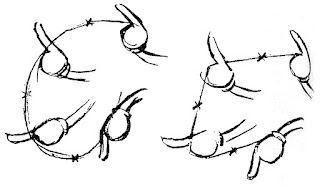 |
| Path of Action from "The Illusion of Life" |
A moving object should follow a smooth flowing arc,
without any sudden abrupt changes of direction.
Monday, 27 January 2020
Horse Animation - Free Maya Rigs

The Animation Apprentice official site (to which all our students have access) has a series of horse video tutorials, teaching students how to animate a walk, a trot and a run.
Thursday, 4 April 2019
Art Babbitt and "Successive Breaking of Joints"
 |
| Art Babbitt & Richard Williams in Soho c1973 |
The basic underlying premise is that in any action, everything shouldn't happen at the same time.
It was an idea developed by Disney animator Art Babbit, who gave a series of animation lectures at Richard Williams Animation in Soho in the 1970s.
Tuesday, 12 March 2019
The Importance of Anticipation
 |
| Anticipation - Illusion of Life |
Every action tends to have three components: an anticipation, an action, and a reaction. If you make the anticipation clear, then the rest should follow effortlessly.
Consider the anticipation drawing of Donal Duck on the left, taken from the classic Disney instruction manual "The Illusion of Life" - still a must-have book on every animator's shelf.
It's absolutely clear what Donald is about to do - even though he hasn't done it yet.
The trick with a good anticipation pose is that it is made so clear that the audience knows what the character is going to do, before he or she actually does it.
Wednesday, 10 October 2018
How Do Animators Time Animation?
 |
| How to time animation? |
This is a good question, very commonly asked by junior animators - and a tough one to answer. The short answer is that it takes time, and patience, as a thorough knowledge of timing and spacing takes a while to acquire.
However, one simple approach is time out an action with a stopwatch, or the timer on your phone, to get an idea of how long an action will take. Some animators will count out "one one thousand, two one thousand"... to figure out how many seconds an action might take.
But the best system of all for newbies is to use live-action reference.
Thursday, 15 February 2018
Aaron Hartline Explains the Line of Action
 |
| Aaron Hartline |
Later that day, Aaron gave a great talk at Escape Studios in Shepherd's Bush about some of the important principles of animation, including the Line of Action - a concept first developed by Disney animator Preston Blair, who published one of the first practical books on learning animation back in the 1950s.
Subscribe to:
Posts (Atom)